
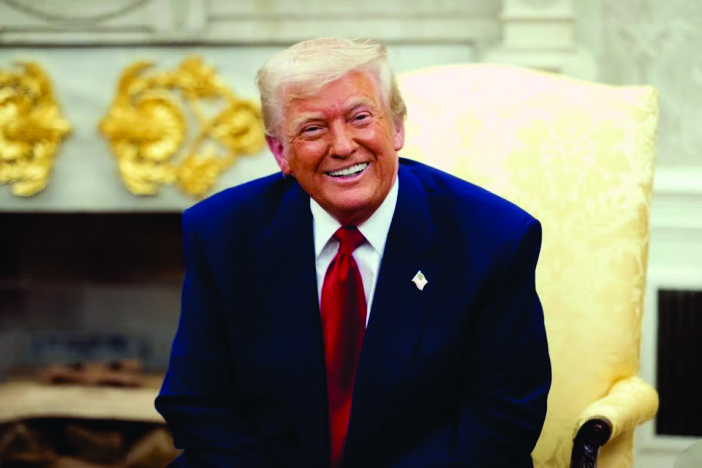
The United States and Iran have successfully concluded a historic peace framework, resulting in the immediate lifting of the United States naval blockade and the slated reopening of the strategically critical Strait of Hormuz.
United States President Donald J. Trump announced the completion of the diplomatic breakthrough via social media, declaring that a final memorandum of understanding has been achieved. In an official statement, the President noted: “The Deal with the Islamic Republic of Iran is now complete. Congratulations to all! I hereby fully authorize the toll free opening of the Strait of Hormuz, and, simultaneously herewith, authorize the immediate removal of the United States Naval blockade. Ships of the World, start your engines. Let the oil flow! President DONALD J. TRUMP.”
The resolution effectively brings an end to months of intense military hostilities that had severely restricted maritime traffic through the narrow waterway, through which approximately 20 percent transits. Iranian diplomatic sources and regional mediators confirmed that the formal signing ceremony is scheduled to take place in Switzerland on Friday, June 19, 2026, after which standard commercial shipping operations are expected to resume in full.
Global equity markets rally on breakthrough
Stock markets across the Asia Pacific have surged following the announcement of a deal between Washington and Tehran to end the U.S.-Israel war on Iran.
Japan’s Nikkei 225 benchmark index soared 5.5 percent in morning trading on Monday, while South Korea’s Kospi jumped as much as 5.7 percent. Taiwan’s Taiex climbed as much as 2.7 percent, while the ASX200 in Australia rose about 1.5 percent. In Hong Kong, the Hang Seng Index rose about 1 percent, before giving up most of its gains later in the morning.
Futures for U.S. stocks, which are traded outside of regular market hours, also climbed, with those tied to the benchmark S&P500 and the tech-focused Nasdaq Composite rising about 1 percent and 1.8 percent, respectively.
Energy markets retreat on supply relief
The announcement precipitated a sharp downward correction in global energy markets as traders factored in the imminent restoration of Gulf oil flows and a dramatic reduction in supply disruption risks.
On commercial exchanges, Brent crude oil futures tumbled by more than 4 percent, falling to approximately $84 a barrel, marking its lowest trading valuation since March. Simultaneously, West Texas Intermediate (WTI) crude oil futures plummeted by roughly 4.94 percent, settling near the $80.69 a barrel mark. The sudden influx of anticipated supply erased much of the geopolitical risk premium that had inflated energy costs throughout the duration of the conflict.
Precious metals surge amid easing inflationary pressures
Conversely, precious metals experienced substantial upward momentum following the announcement. The de-escalation of the Middle East conflict alleviated widespread macroeconomic anxieties regarding energy-driven inflation, which in turn softened expectations for aggressive monetary tightening by major central banks and exerted downward pressure on the United States dollar.
Spot gold surged by 2.3 percent to trade at $4,317.32 an ounce, rebounding strongly from multi-month lows registered during the previous week. United States gold futures for August delivery mirrored this trajectory, advancing by 2.4 percent to reach $4,338.75 an ounce. Other precious metals followed the broader commodities rally, with silver prices jumping by 3.3 percent to settle at $70.24 an ounce.
Source: economymiddleeast