
Before Russia’s 2022 invasion of Ukraine turned it into the new pariah of the West, Iran was the most sanctioned country on Earth: more than 3,600 economic sanctions imposed by the United States, the United Nations, the European Union, and various other countries, measures that forced the Islamic Republic to reshape its economic policy to circumvent these obstacles. That included its vital oil sector, which U.S. President Donald Trump hoped to choke through the U.S. blockade of the Strait of Hormuz, the route through which Iran exports 90% of the crude it sells abroad.
On April 27, Trump predicted that with tankers stranded in Hormuz and oil storage facilities full, Iran’s pipelines and wells would begin to “explode” within three days. Two weeks later, there is no sign of such a cinematic scenario. Meanwhile, several experts warn that the timeframe for truly crippling Iran’s oil sector by depriving it of the bulk of its exports is not measured in days but likely in months.
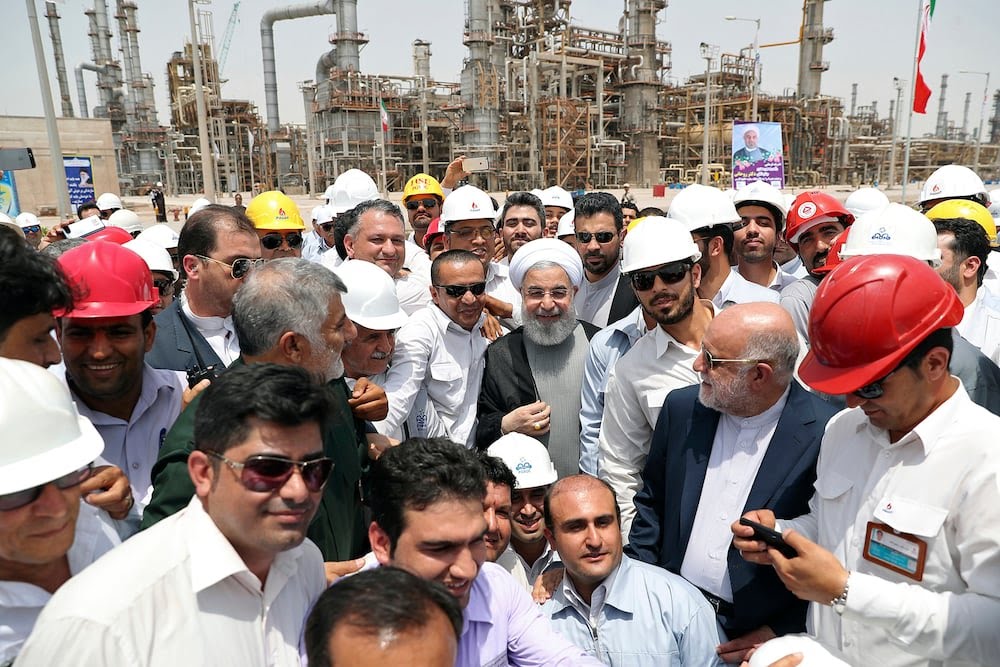
A photograph taken almost 10 years ago, on April 30, 2017, offers clues as to how Iran’s hydrocarbons sector is, for now, weathering the Hormuz blockade without any sign — at least none publicly known — of the permanent infrastructure damage Trump predicted. In that image, Iran’s then‑president, the moderate cleric Hassan Rouhani, smiles flanked by helmeted workers. In the background stand the facilities known as the Persian Gulf Star, in the southern city of Bandar Abbas —the world’s largest gas‑condensate refinery, designed to produce fuel for Iran’s domestic market and thus reduce the country’s gasoline and diesel imports. Very close to its stacks rises another crude‑processing and petroleum‑products plant: the Bandar Abbas refinery, Iran’s third largest.
In the weeks leading up to the start of U.S. and Israeli airstrikes on February 28, Iran was producing around 3.3 million barrels per day of crude and another 1.3 million barrels per day of condensate and other petroleum derivatives. Yet most of that output was neither destined for export through Hormuz nor for storage. According to the energy consultancy FGE, 2.6 million barrels per day were being processed before the war in Iranian refineries for domestic consumption.
Even so, the country was far from meeting — and is even further now, with Hormuz closed — its high domestic fuel demand, and has to import supplies. Last Thursday, a member of the Iranian Parliament’s Energy Commission, Mostafa Nakhai, said the country is facing a daily gasoline shortfall of around 20 million liters due to the blockade of the strait, reports Ali Falahi.
A significant share of Iran’s crude is refined; another portion is exported. The Islamic Republic also sells other petroleum products abroad, such as liquefied petroleum gas (LPG) and bitumen — the main component of asphalt. Some of these products, especially LPG, are exported by ship through Hormuz, while others are transported by road to countries like Pakistan and Afghanistan, though that route has far more limited capacity than shipping.
Source: english.elpais