
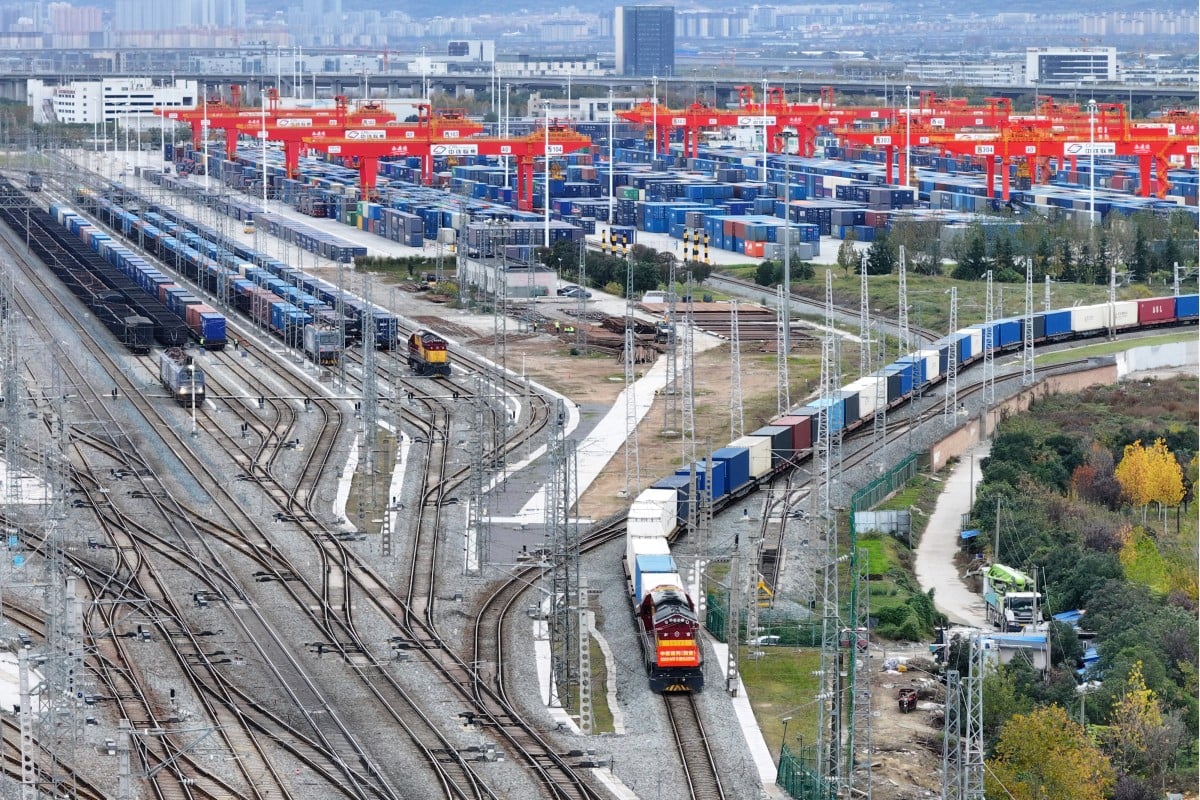
A new report recommends European companies avoid an overreliance on China or the US in their supply chains, as companies find themselves squeezed between Beijing’s preferential policies for local companies and Washington’s trade volatility.
The European Union Chamber of Commerce in China advised companies to “eliminate single-source dependencies on both China and the United States where possible” in its “Dealing with Supply Chain Dependencies” report released on Wednesday.
“We are probably only seeing the very tip of the iceberg when it comes to understanding dependencies,” the chamber’s president, Jens Eskelund, said at an earlier media briefing, at which he noted European industries’ deep reliance on Chinese inputs.
While the strength of China’s industrial clusters means many global companies remain reliant on its supply chains to stay competitive, the report said the fallout from recent geopolitical shocks had underscored the urgent need to diversify away from single-country dependencies.
That scrutiny extends to the US, the report showed, with the Trump administration’s unpredictable use of tariffs and flip-flopping on trade deals leading some member companies interviewed by the chamber to view China as being comparatively more reliable.
China’s trade surplus has surpassed US$1 trillion for the first time this year, according to data released this week, even as shipments to the US declined amid a bilateral tariff war.
Following a visit to China last week, French President Emmanuel Macron warned Beijing that Europe would be forced to retaliate with “strong measures” against Chinese goods – including punitive tariffs modelled after US policy – if a trade imbalance between the two sides remained unaddressed next year.
In a story published on Sunday, the business newspaper Les Echos quoted Macron as saying that China was “effectively killing their own customers” by running unsustainable surpluses while curbing imports.
“I told them that if they do not react, we Europeans will be forced, in the next several months, to take strong measures and to de-cooperate, following the example of the United States – for instance, by imposing tariffs on Chinese products,” he said.
Growing trade imbalances, combined with Beijing’s previous moves to restrict exports of rare earths – measures that were paused following high-level talks with the US – and disputes over Dutch semiconductor company Nexperia, have deepened European anxiety over supply chain security.
Source: scmp