
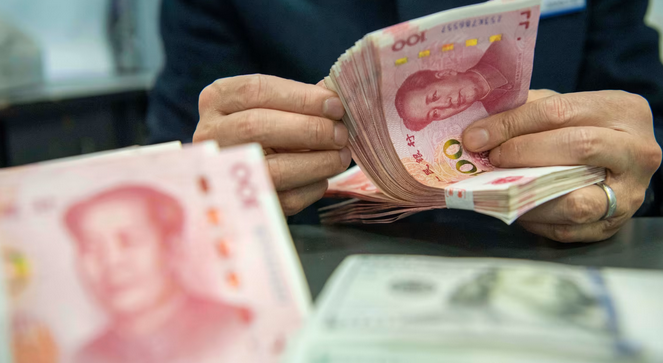
China is seizing an opportunity to challenge American dominance in global finance and exert greater international influence at the expense of the all-powerful US dollar.
Geopolitical uncertainty – driven in large part by President Donald Trump’s often chaotic economic policy – has gripped markets in recent weeks, with the dollar falling to four-year lows. Meanwhile, investors are flocking to safe-haven assets, driving gold prices to record highs of more than $5,500 an ounce. That’s given China an opening to promote its own currency as a viable alternative.
Over the weekend, the flagship ideology journal of China’s Communist Party published remarks from President Xi Jinping that outlined plans to turn the renminbi into a global reserve currency. That’s the role the US dollar currently plays – the go-to currency for the vast majority of foreign transactions, making it one of the world’s safest investments.
No one expects that to change anytime soon. But the steep decline in the dollar’s value since Trump took office again last year has at least opened the door to potential challengers.
According to the journal Qiushi, Xi told government officials that China should aspire to establish “a strong currency widely used in international trade and foreign exchange,” with a “powerful central bank” and the ability to attract investment and influence global pricing.
China is seizing an opportunity to challenge American dominance in global finance and exert greater international influence at the expense of the all-powerful US dollar.
Geopolitical uncertainty – driven in large part by President Donald Trump’s often chaotic economic policy – has gripped markets in recent weeks, with the dollar falling to four-year lows. Meanwhile, investors are flocking to safe-haven assets, driving gold prices to record highs of more than $5,500 an ounce. That’s given China an opening to promote its own currency as a viable alternative.
Over the weekend, the flagship ideology journal of China’s Communist Party published remarks from President Xi Jinping that outlined plans to turn the renminbi into a global reserve currency. That’s the role the US dollar currently plays – the go-to currency for the vast majority of foreign transactions, making it one of the world’s safest investments.
No one expects that to change anytime soon. But the steep decline in the dollar’s value since Trump took office again last year has at least opened the door to potential challengers.
According to the journal Qiushi, Xi told government officials that China should aspire to establish “a strong currency widely used in international trade and foreign exchange,” with a “powerful central bank” and the ability to attract investment and influence global pricing.
The Chinese leader’s comments were made privately in 2024. The party publicized them as China is positioning itself as a more reliable economic and political partner than the US – and starting to see results. Here’s what we know.
Why do China’s plans matter now?
China has spent over a decade trying to integrate the renminbi into international markets and ensure its stability as a global currency. But China has recently begun reaping the benefits of growing concerns over US economic policy and a trend known as “de-dollarization.”
Trump’s decision to impose several rounds of tariffs on major trade partners has undermined confidence in economic growth in the US and the value of its currency. A change in leadership at the Federal Reserve – for which Trump has nominated Kevin Warsh after repeatedly clashing with current chair Jerome Powell – has added to the uncertainty around US monetary policy and interest rates.
Investors have been reducing exposure to the dollar since as early as last year, and European Central Bank President Christine Lagarde has called for the euro to take on a larger role in global finance. The threat of duties and sanctions imposed by the US has also prompted some nations to look to hedge their reliance on the dollar.
“To get people to use renminbi, you’ve kind of got to carve out a niche, and it’s been really difficult,” said Dinny McMahon, head of markets research at the research firm Trivium China. “Now the way that the Party thinks about it is, ‘Oh, we’re in a really unique moment in time, because people are becoming disillusioned with the dollar.’”
The dollar has been central to the global economy for more than 80 years, following World War II and the Bretton Woods Agreement that set the dollar as the gold-backed standard and pegged 44 other currencies to it. Strong demand for dollars gives the US more influence in borrowing money overseas at low rates and imposing sanctions on other nations.
The International Monetary Fund recognizes seven other major reserve currencies, including euros, renminbi, Japanese yen, Canadian dollars, Australian dollars, pounds sterling and Swiss francs. China has sought to strengthen its own currency’s standing as a way to insulate itself from US financial hegemony and pressures, as well as increasing its own political and economic influence in global trade and finance.
Source: CNN